Software Provider and Product Assessment
Product Intelligence
In today’s digital landscape, gaining insights into digital product representations through technology can be complex. The vast amounts of consumer interaction data generated can reveal performance metrics and growth opportunities. Digital reviews and advanced analytics quickly identify trends and address challenges, with product definitions serving as references for optimizing consumer guidance. A data-driven approach supports informed decisions and drives sustained digital growth.

ISG Research defines product intelligence as the digital practices and processes that optimize interactions between consumers and enterprise systems used for information and commerce.
ISG Research defines product intelligence as the digital practices and processes that optimize interactions between consumers and enterprise systems used for information and commerce. It provides tools for managing digital interactions through analytics and automation, utilizing AI and other techniques.
The evolution of product intelligence stems from over two decades of advancements in content and web analytics. These analytics have progressively supported the experimentation and testing of web content, transforming the digital representation of features and services to achieve optimal results. Initially, in the mid-1990s, websites relied on basic tracking methods using server logs to monitor user interactions, providing fundamental metrics like page views and unique visitors. These early tools offered minimal insights into user behavior. However, as the internet expanded, the demand for more sophisticated analytics grew, paving the way for solutions that incorporated product-focused metrics.
The launch of Google Analytics in the early 2000s marked a transformative shift, democratizing access to analytics tools. Although these tools provided significant improvements, they did not fully meet the needs for more advanced analysis. With the infusion of product intelligence, marketers gained the ability to analyze not just traffic sources and user demographics, but also digital product performance and user engagement on a deeper level within the context of user journeys. This integration of digital intelligence into web analytics frameworks has significantly evolved the field, allowing for more comprehensive and actionable insights.
The continued evolution of web analytics has been further enhanced by the emergence of AI and machine learning technologies, imbuing analytics processes with digital intelligence. These advancements enable predictive analytics, allowing businesses to foresee user behavior and optimize product offerings based on real-time data. Today, web analytics encompasses various techniques, including conversion rate optimization, A/B testing and multi-channel attribution. This comprehensive approach enables enterprises to make informed decisions regarding digital product and marketing strategies, enhancing user experiences and navigating the complexities of the online marketplace. Ultimately, this evolution has solidified web analytics as an essential tool for effective digital marketing and product management.
To enhance digital operations and drive growth in today’s data-driven environment, enterprises must strategically implement product intelligence. This involves adopting advanced platforms for real-time insights into consumer behavior and product performance. Product intelligence enables organizations to move beyond traditional analytics, providing a comprehensive understanding of user interactions and preferences for informed decision-making.
By 2028, one-third of enterprises will have invested in a common technological approach for product information management that is committed to product experiences and not just digital assets. Incorporating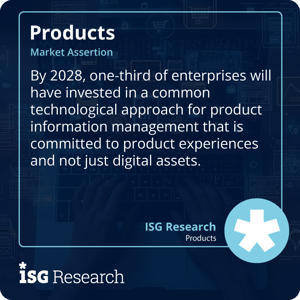 AI and machine learning into digital intelligence frameworks is crucial. These technologies enable predictive analytics, helping businesses anticipate customer needs and behaviors, which leads to personalized experiences and optimized product offerings. Techniques such as journey mapping, sentiment analysis and performance metrics enhance market understanding and improve strategies. Integrating digital intelligence increases enterprise agility, improves customer engagement and helps navigate the complexities of the digital landscape, securing a sustainable competitive advantage.
To thrive in this data-driven landscape, enterprises should invest in platforms that provide real-time insights and use methods like experimentation and testing for optimal performance. Moving beyond traditional metrics allows for a holistic view of user interactions, informing strategic decisions. By prioritizing AI and machine learning technologies, predictive analytics can better anticipate customer needs, enabling personalized experiences and optimized offerings. This comprehensive approach refines overall strategies, ultimately improving agility and enhancing consumer engagement.
Technology is essential for enterprises to effectively implement product intelligence in today’s digital, data-driven environment. With vast amounts of data generated across various channels, advanced platforms are necessary for real-time processing and analysis to ensure critical insights are not missed. AI and machine learning technologies enhance predictive analytics, enabling businesses to anticipate customer needs, create personalized experiences and optimize product offerings. Adopting technology is fundamental for extracting value from digital intelligence, improving customer engagement and maintaining a competitive edge in a complex digital landscape.
Optimizing product descriptions with SEO techniques and competitive pricing strategies will strengthen market positions. Utilizing AI and machine learning for predictive analytics will uncover new opportunities and mitigate risks. Structured product scorecards and digital dashboards will effectively measure performance, while insights from digital shelf analytics and sentiment analysis will enhance understanding of customer feedback. Integrating automated notification systems for real-time monitoring of compliance and product activity provides valuable insights for agile decision-making.
Providing technology that meets the diverse needs of product and technology professionals is crucial for guiding operations and informed decision-making.
To harness product intelligence effectively, enterprises should take several strategic steps. First, they need to invest in advanced platforms that offer real-time insights into consumer behavior and digital interactions. Employing AI and machine learning technologies will enhance predictive analytics capabilities, allowing businesses to better anticipate consumer needs. Implementing journey mapping techniques will help gain a comprehensive understanding of user interactions and preferences. Focusing on personalization will enable organizations to create tailored experiences based on insights gathered from data analysis. It is also essential to enhance product data governance to ensure clean, accurate and compliant data practices, maximizing the value of product intelligence. Finally, providing technology that meets the diverse needs of product and technology professionals is crucial for guiding operations and informed decision-making. By following these steps, enterprises can improve digital engagement, adapt to market changes and achieve a sustainable competitive advantage.
The ISG Buyers Guide™ for Product Intelligence evaluates software providers and products in key areas that require support for digital representation of what we call product intelligence, and underlying support in content and data management, support for integration into digital systems, and the support for analyst, product managers, operations and administrative roles. Examination of digital innovation and investment were examined.
This research evaluates the following software providers that offer products that address key elements of product intelligence as we define it: Adobe, Amplitude, Contentsquare, Fullstory, Gainsight, Glassbox, MixPanel, Pendo, QuantumMetric and Sensor Tower.
Buyers Guide Overview
For over two decades, ISG Research has conducted market research in a spectrum of areas across business applications, tools and technologies. We have designed the Buyers Guide to provide a balanced perspective of software providers and products that is rooted in an understanding of the business requirements in any enterprise. Utilization of our research methodology and decades of experience enables our Buyers Guide to be an effective method to assess and select software providers and products. The findings of this research undertaking contribute to our comprehensive approach to rating software providers in a manner that is based on the assessments completed by an enterprise.
ISG Research has designed the Buyers Guide to provide a balanced perspective of software providers and products that is rooted in an understanding of business requirements in any enterprise.
The ISG Buyers Guide™ for Product Intelligence is the distillation of over a year of market and product research efforts. It is an assessment of how well software providers’ offerings address enterprises’ requirements for product intelligence software. The index is structured to support a request for information (RFI) that could be used in the request for proposal (RFP) process by incorporating all criteria needed to evaluate, select, utilize and maintain relationships with software providers. An effective product and customer experience with a provider can ensure the best long-term relationship and value achieved from a resource and financial investment.
In this Buyers Guide, ISG Research evaluates the software in seven key categories that are weighted to reflect buyers’ needs based on our expertise and research. Five are product-experience related: Adaptability, Capability, Manageability, Reliability, and Usability. In addition, we consider two customer-experience categories: Validation, and Total Cost of Ownership/Return on Investment (TCO/ROI). To assess functionality, one of the components of Capability, we applied the ISG Research Value Index methodology and blueprint, which links the personas and processes for PIM to a manufacturing enterprise’s requirements.
The structure of the research reflects our understanding that the effective evaluation of software providers and products involves far more than just examining product features, potential revenue or customers generated from a provider’s marketing and sales efforts. We believe it is important to take a comprehensive, research-based approach, since making the wrong choice of manufacturing-related PIM technology can raise the total cost of ownership, lower the return on investment and hamper an enterprise’s ability to reach its full performance potential. In addition, this approach can reduce the project’s development and deployment time and eliminate the risk of relying on a short list of software providers that does not represent a best fit for your enterprise.
ISG Research believes that an objective review of software providers and products is a critical business strategy for the adoption and implementation of manufacturing-related PIM software and applications. An enterprise’s review should include a thorough analysis of both what is possible and what is relevant. We urge manufacturing enterprises to do a thorough job of evaluating PIM systems and tools and offer this Buyers Guide as both the results of our in-depth analysis of these providers and as an evaluation methodology.
How To Use This Buyers Guide
Evaluating Software Providers: The Process
We recommend using the Buyers Guide to assess and evaluate new or existing software providers for your enterprise. The market research can be used as an evaluation framework to establish a formal request for information from providers on products and customer experience and will shorten the cycle time when creating an RFI. The steps listed below provide a process that can facilitate best possible outcomes.
- Define the business case and goals.
Define the mission and business case for investment and the expected outcomes from your organizational and technology efforts. - Specify the business needs.
Defining the business requirements helps identify what specific capabilities are required with respect to people, processes, information and technology. - Assess the required roles and responsibilities.
Identify the individuals required for success at every level of the organization from executives to front line workers and determine the needs of each. - Outline the project’s critical path.
What needs to be done, in what order and who will do it? This outline should make clear the prior dependencies at each step of the project plan. - Ascertain the technology approach.
Determine the business and technology approach that most closely aligns to your organization’s requirements. - Establish technology vendor evaluation criteria. Utilize the product experience: Adaptability, Capability, Manageability, Reliability and Usability, and the customer experience in TCO/ROI and Validation.
- Evaluate and select the technology properly. Weight the categories in the technology evaluation criteria to reflect your organization’s priorities to determine the short list of vendors and products.
- Establish the business initiative team to start the project.
Identify who will lead the project and the members of the team needed to plan and execute it with timelines, priorities and resources.
The Findings
All of the products we evaluated are feature-rich, but not all the capabilities offered by a software provider are equally valuable to types of workers or support everything needed to manage products on a continuous basis. Moreover, the existence of too many capabilities may be a negative factor for an enterprise if it introduces unnecessary complexity. Nonetheless, you may decide that a larger number of features in the product is a plus, especially if some of them match your enterprise’s established practices or support an initiative that is driving the purchase of new software.
Factors beyond features and functions or software provider assessments may become a deciding factor. For example, an enterprise may face budget constraints such that the TCO evaluation can tip the balance to one provider or another. This is where the Value Index methodology and the appropriate category weighting can be applied to determine the best fit of software providers and products to your specific needs.
Overall Scoring of Software Providers Across Categories
The research finds Pendo atop the list, followed by Amplitude and Quantum Metric. Companies that place in the top three of a category earn the designation of Leader. Amplitude has done so in six categories; Pendo in five; Adobe and Quantum Metric in three; and Gainsight, Glassbox, Contentsquare and Mixpanel in one category.
The overall representation of the research below places the rating of the Product Experience and Customer Experience on the x and y axes, respectively, to provide a visual representation and classification of the software providers. Those providers whose Product Experience have a higher weighted performance to the axis in aggregate of the five product categories place farther to the right, while the performance and weighting for the two Customer Experience categories determines placement on the vertical axis. In short, software providers that place closer to the upper-right on this chart performed better than those closer to the lower-left.
The research places software providers into one of four overall categories: Assurance, Exemplary, Merit or Innovative. This representation classifies providers’ overall weighted performance.
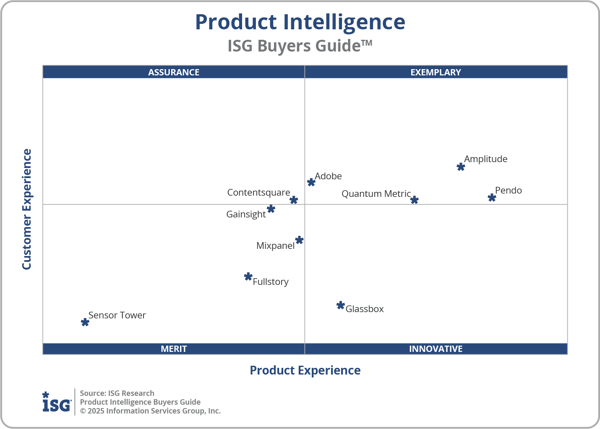
Exemplary: The categorization and placement of software providers in Exemplary (upper right) represent those that performed the best in meeting the overall Product and Customer Experience requirements. The providers rated Exemplary are: Adobe, Amplitude, Pendo and Quantum Metric.
Innovative: The categorization and placement of software providers in Innovative (lower right) represent those that performed the best in meeting the overall Product Experience requirements but did not achieve the highest levels of requirements in Customer Experience. The provider rated Innovative is: Glassbox.
Assurance: The categorization and placement of software providers in Assurance (upper left) represent those that achieved the highest levels in the overall Customer Experience requirements but did not achieve the highest levels of Product Experience. The provider rated Assurance is: Contentsquare.
Merit: The categorization of software providers in Merit (lower left) represents those that did not exceed the median of performance in Customer or Product Experience or surpass the threshold for the other three categories. The provider's rated Merit are: Fullstory, Gainsight, Mixpanel and Sensor Tower.
We warn that close provider placement proximity should not be taken to imply that the packages evaluated are functionally identical or equally well suited for use by every enterprise or for a specific process. Although there is a high degree of commonality in how enterprises handle product intelligence, there are many idiosyncrasies and differences in how they do these functions that can make one software provider’s offering a better fit than another’s for a particular enterprise’s needs.
We advise enterprises to assess and evaluate software providers based on organizational requirements and use this research as a supplement to internal evaluation of a provider and products.
Product Experience
The process of researching products to address an enterprise’s needs should be comprehensive. Our Value Index methodology examines Product Experience and how it aligns with an enterprise’s life cycle of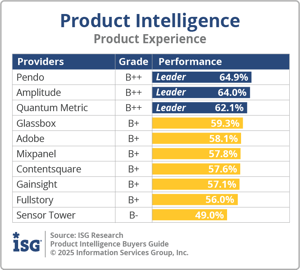 onboarding, configuration, operations, usage and maintenance. Too often, software providers are not evaluated for the entirety of the product; instead, they are evaluated on market execution and vision of the future, which are flawed since they do not represent an enterprise’s requirements but how the provider operates. As more software providers orient to a complete product experience, evaluations will be more robust.
The research results in Product Experience are ranked at 80%, or four-fifths, of the overall rating using the specific underlying weighted category performance. Importance was placed on the categories as follows: Usability (20%), Capability (20%), Reliability (15%), Adaptability (10%) and Manageability (15%). This weighting impacted the resulting overall ratings in this research. Pendo, Amplitude and Quantum Metric were designated Product Experience Leaders.
Adaptability of the Product
This category assesses the degree to which products and technology can be adapted to an enterprise’s specifications via configurability and customization while still maintaining integrity of integration across the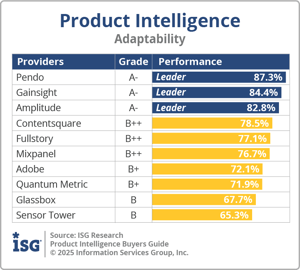 worker, device, business, processes, application and data. Adaptability is also related to the ability to readily integrate with other internal and external systems—for example, integrate data and information securely across processes and systems—and support bidirectional data flows to support synchronization and migration. It also examines the investment by the software provider in resources and improvements.
The research weights Adaptability at 10% of the overall rating. Pendo, Gainsight and Amplitude are the Leaders in this category.
Adaptability is an essential evaluation metric as it determines the flexibility and interconnectivity of the software provider’s product related to enterprise requirements. It also enables enterprise software to operate across the variety of platforms and cloud computing environments that exist today and in the future.
Software providers that evaluated well in the Adaptability category understand the criticality of preparing and using information to optimize business execution. These providers meet the specific customization and integration support requirements in these areas, enabling enterprises to process data across business processes, workflows and applications as they operate.
Manageability of the Product
Manageability is evaluated by how well the products can be managed technologically and by business, and governed, secured, licensed and supported in a service level agreement (SLA). Also important is the flexibility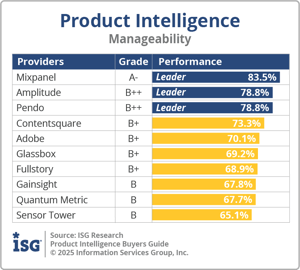 of the privacy and security provisions built into the technology with respect to user identity, role and access, how effective that security is, to what extent it supports auditing and compliance, and what licensing or subscription is available from the software provider. It also examines the investment by the provider in resources and improvements.
The research weights Manageability at 15% of the overall rating. Mixpanel, Amplitude and Pendo are the Leaders in this category.
Manageability is an essential evaluation metric to indicate whether the software provider’s product can be administrated and supported throughout its life cycle in the enterprise. It also ensures the overall efficiency, compliance and security of the enterprise software.
A software provider’s performance in the evaluation criteria is especially critical when examining business and technology administration. Providers that did not perform well had challenges with administration, configuration by authorized personnel, license, use and audit. The significance to provide information security cannot be overstated as the insights and knowledge of an enterprise are present in the data. The growing importance of simplifying manageability is critical and should be a priority for all software provider evaluations.
Reliability of the Product
For product intelligence processes to operate efficiently and for workers to engage the applications, the software on which they run must reliably deliver the necessary performance and scalability using the existing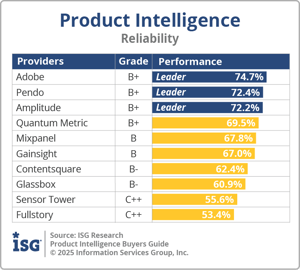 architecture operating across the enterprise and cloud computing environments. The criteria include depth in the performance and scalability of a software provider’s products and architecture, including the metrics to ensure operations and configurability across data, users, instances, activities and tasks. It also examines the investment by the provider in resources and improvements.
The research weights Reliability at 15% of the overall rating. Adobe, Pendo and Amplitude are the Leaders in this category, providing the highest level of confidence that they can operate at any level of reliability 24 hours a day.
Reliability is an essential evaluation metric as it indicates the product’s ability to perform and scale to the defined enterprise requirements and how well it supports the continuous processing required for business continuity and operational resilience today and into the future.
Evaluating the performance and scalability readiness of software is not always easy as it depends on the type of product information and the volume at which the data is being updated and used by processes and systems. Software providers that did not perform well in this category were not able to provide this level of information at any depth, even though it is necessary to establish the confidence required for provider selection.
Customer Experience
The importance of a customer relationship with a software provider is essential to the actual success of the products and technology. The advancement of the Customer Experience and the entire life cycle an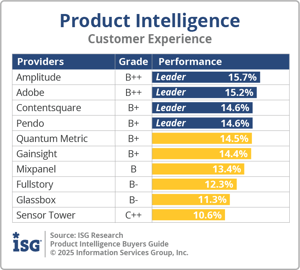 enterprise has with its software provider is critical for ensuring satisfaction in working with that provider. Technology providers that have chief customer officers are more likely to have greater investments in the customer relationship and focus more on their success. These leaders also need to take responsibility for ensuring this commitment is made abundantly clear on the website and in the buying process and customer journey.
The research results in Customer Experience are ranked at 20%, or one-fifth, using the specific underlying weighted category performance as it relates to the framework of commitment and value to the software provider-customer relationship. The two evaluation categories are Validation (10%) and TCO/ROI (10%), which are weighted to represent their importance to the overall research.
The software providers that evaluated the highest overall in the aggregated and weighted Customer Experience categories are Amplitude, Adobe, Contentsquare and Pendo. These category leaders best communicate commitment and dedication to customer needs. While not a Leader, Quantum Metric and Gainsight were also found to meet a broad range of enterprise customer experience requirements.
Software providers that did not perform well in this category were unable to provide sufficient customer case studies to demonstrate success or articulate their commitment to customer experience and an enterprise’s journey. The selection of a software provider means a continuous investment by the enterprise, so a holistic evaluation must include examination of how they support their customer experience.
Pendo
Company and Product Profile
Pendo Analytics, released January 2025
“Pendo, the most comprehensive product experience platform, allows companies to put product at the center of everything they do. We help teams integrate product intelligence into their organizations to confidently innovate at the speed of changing user needs—taking the guesswork out of delivering the best product experiences. Make better decisions with Pendo's product analytics tool. Learn everything about your customers so you can improve everything about their digital experiences.” – Pendo
Summary
Our analysis classified Pendo as Exemplary, receiving an overall grade of B++ with a 79.6% performance. Pendo's best grouped results came in Product Experience with an 81.5% performance and an A- grade, due in part to its A- in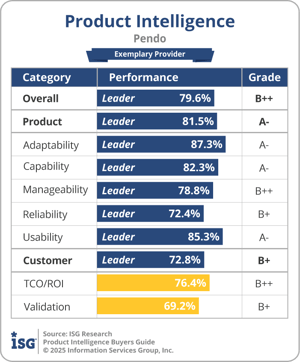 Adaptability. In Customer Experience, Pendo received a B+ grade with a 72.8% performance due to its 76.4% performance in TCO/ROI. Pendo was designated an Overall Leader as well as a Leader in Product Experience, Adaptability, Capability, Manageability, Reliability, Usability and Customer Experience.
Challenges
Pendo's B+ in Customer Experience was impacted by its B+ in Validation, where it could improve its references. Product Experience was impacted by its B+ in Reliability, where it could enhance user configurability to optimize performance.
Strengths
Pendo performed best in Product Experience with an A- grade, notably in Adaptability, where it received an A- due to the quality of results from its investments in adaptability. Pendo received a B+ grade in Customer Experience, with a B++ in TCO/ROI due to the quality of documentation to assist buyer in calculating TCO.
Appendix: Software Provider Inclusion
For inclusion in the ISG Buyers Guide™ for Product Intelligence in 2025, a software provider must be in good standing financially and ethically, have at least $15 million in annual or projected revenue verified using independent sources, sell products and provide support on at least two continents, and have at least 50 customers. The principal source of the relevant business unit’s revenue must be software-related, and there must have been at least one major software release in the last 12 months.
The ISG Buyers Guide™ for Product Intelligence evaluates software providers and products in key areas that require support for digital representation of what we call product intelligence, and should have underlying support in content and data management, support for integration into digital systems, and the support for analyst, product managers, operations and administrative roles. Extent of digital innovation and investment were examined.
The research is designed to be independent of the specifics of software provider packaging and pricing. To represent the real-world environment in which businesses operate, we include providers that offer suites or packages of products that may include relevant individual modules or applications. If a software provider is actively marketing, selling and developing a product for the general market and it is reflected on the provider’s website that the product is within the scope of the research, that provider is automatically evaluated for inclusion.
All software providers that offer relevant product intelligence products and meet the inclusion requirements were invited to participate in the evaluation process at no cost to them.
Software providers that meet our inclusion criteria but did not completely participate in our Buyers Guide were assessed solely on publicly available information. As this could have a significant impact on classification and ratings, we recommend additional scrutiny when evaluating those providers.
Products Evaluated
|
Provider |
Product Names |
Version |
Release |
|
Adobe |
Adobe Experience Cloud, Adobe Analytics |
February 2025 |
February 2025 |
|
Amplitude |
Amplitude Platform |
February 2025 |
February 2025 |
|
Contentsquare |
Heap, Hotjar, Product Analytics |
February 2025 |
February 2025 |
|
Fullstory |
Product Analytics |
February 2025 |
February 2025 |
|
Gainsight |
Product Experience |
v. 4.20.0 |
February 2025 |
|
Glassbox |
Glassbox Platform |
January 2025 |
January 2025 |
|
Mixpanel |
Mixpanel Product Analytics, Session Replay, Warehouse Connectors |
February 2025 |
February 2025 |
|
Pendo |
Pendo Analytics |
January 2025 |
January 2025 |
|
Quantum Metric |
Digital Analytics Platform |
v. summer |
September 2024 |
|
Sensor Tower |
App Performance Insights, Audience Insights, Pathmatics, Web Insights |
January 2025 |
January 2025 |
Providers of Promise
We did not include software providers that, as a result of our research and analysis, did not satisfy the criteria for inclusion in this Buyers Guide. These are listed below as “Providers of Promise.”
|
Provider |
Product |
Revenue |
Geography |
Customers |
Functionality |
|
Kissmetrics |
Kissmetrics |
No |
Yes |
Yes |
Yes |
|
LogRocket |
LogRocket |
No |
Yes |
Yes |
Yes |
|
Mouseflow |
Mouseflow |
No |
Yes |
Yes |
Yes |
|
PostHog |
Product Analytics, Web Analytics |
No |
Yes |
Yes |
Yes |
|
Userpilot |
Userpilot |
No |
Yes |
Yes |
Yes |
|
UserVoice |
Uservoice |
No |
Yes |
Yes |
Yes |
|
Woopra |
Woopra |
No |
Yes |
Yes |
Yes |